Close this alert

New Release
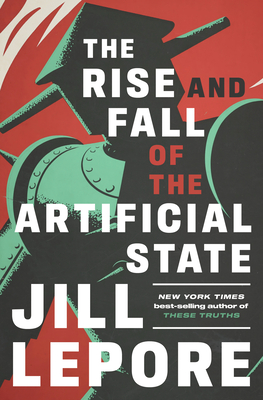
The Rise and Fall of the Artificial State
Current price:
$29.99
Publish Date:
Publisher:
Liveright
ISBN:
9781324098423
Pages:
336
Language:
English
Not On Our Shelves. Arrival estimation 5-10 business days.

Lepore does a masterful job laying out how we got to this point with AI and the role a small number of tech billionaires play in our lives. Their inspirations are frightening and something everyone should know. What we do with that knowledge is up to us!
September 2026 Indie Next List
Description
Longlisted for the Financial Times Business Book of the Year
Best Books of August: Barnes & Noble, Goodreads
A New York Times New and Notable Title
“Lepore is our best scholar of the culture of governance, and our most vital historian. Here she repudiates the prospect of AI as a replacement for democracy. This is the issue of our times, and Lepore is the voice of sanity.” —Jaron Lanier, author of You Are Not a Gadget
“Much in history is headlong but few grand transformations have been more precipitate or more heedless than the rise of... the Artificial State,” writes Jill Lepore in this passionate account of how rule by machine has ravaged the world. Inspired by Hannah Arendt’s The Origins of Totalitarianism, which argued in 1951 that the machinery of modern life was reshaping the very fundamentals of human existence, Lepore, profoundly disturbed by the technology revolution and by the soulless inundation of artificial intelligence, unfurls a new history for our own twenty-first century.
Building on an essay in The New Yorker in 2024, Lepore’s clarion call traces our increasing dependence on and strangulation by data. Political campaigns, awash in an avalanche of fake bots, have been reduced to attention-mining algorithms, while multinational media corporations dictate public discourse, and the era of the liberal nation-state seems to be coming to a rapid end, replaced by billionaire technocrats reliant on autocracy and the tools of AI.
With Orwellian overtones, The Rise and Fall of the Artificial State demonstrates how technology has corroded global democracy, leading to the destruction of both human community and capacity for self-government, creating a new form of AI government, a digital citizen’s assembly, where AI will recommend the course of action to humans in place of human-run legislatures. Especially sobering with this proliferation of “dizzying, ever-changing schemes, prophesies, and predictions” is that the Artificial State has come at the expense of the natural world, leading to catastrophic loss of wildlife habitat and biodiversity.
Deliberately alarming, The Rise and Fall of the Artificial State, despite its abundance of dire facts, is not a funeral dirge; rather, it’s an inspiring wake-up call, written in Lepore’s typically elegiac prose, which demonstrates that nothing about the Artificial State was inevitable, for it is a “government without consent, even government without humans.” It can, Lepore asserts, be dismantled. Other heinous systems, like feudalism, fascism, and slavery, have also been dismantled, but disassembly requires identifying the parts, tracing the sources. It requires telling a new history. This is the purpose of The Rise and Fall of the Artificial State.
Praise for The Rise and Fall of the Artificial State
Lepore, a historian at Harvard and a staff writer for The New Yorker, traces an origin story for the Artificial State that is at once more surprising and more tragic. . . . Parts of The Rise and Fall of the Artificial State read like an elegy for a vanishing world. But Lepore says it isn’t too late. We humans know how to make a mess of things; we also know how to imagine a different future.
— Jennifer Szalai - New York Times
It’s hard to think of someone better to write a book like this—a history of humanity’s use of technology and data that doubles as a penetrating critique of artificial intelligence, automation, and the increasing tyranny of the algorithm in everyday life. As bleak as Lepore’s diagnosis is, The Rise and Fall of the Artificial State is also a surprisingly hopeful book.
— Alex Shepherd - New Republic
Intriguing, jewel-like stories are Lepore’s hallmark, and The Rise and Fall of the Artificial State sparkles with them. . . . Lepore’s argument that humanity is in the process of ceding vast power to a tiny group of unelected businessmen – some of whom appear to be cartoon supervillains – is a sound one.
— Farrah Jarral - Guardian
A wide-ranging warning about the deleterious effects of Silicon Valley on American democracy . . . . This book is sure to generate [interesting debate] on op-ed pages, podcasts, and newsletters (voilà). Put in your hold now at the library, or you won’t get a copy till next year.
— Ron Charles, Substack
[A] powerful anti-AI treatise . . . . [A] fiery cri de coeur.
— Publishers Weekly, starred review
In this pointed rejoinder to Hannah Arendt’s Origins of Totalitarianism (1951), which foresaw a world in which humans were essentially superfluous, Lepore charts a long history that extends deep into the 'machine age' . . . . A deeply learned dive into the frightening visions of technocrats past and present.
— Kirkus Reviews, starred review
Lepore posits that individuals and institutions have the wherewithal to guide the trajectory of AI towards positive ends, but only if we understand the foundations of its development and the motivations of its developers. An ardent observer of the artificial state, Lepore traces its history through literary influences, such as science fiction and its metamorphosis from simple mechanical engineering to potentially world-destroying system reconfigurations. . . . Staggering, sobering, yet essential reading for all who want to understand the arc of this increasingly digital, online, corporate, and out-of-control world.
— Booklist, starred review
Thoughtful and deeply unsettling . . . . Jill Lepore (We the People) examines our headlong race toward a technology-driven form of governance that she argues is rapidly supplanting liberal democracy, and that may, in its full flowering, deprive us of our very humanity . . . . Her book is an ambitious but concise survey of the historical roots of that idea, contrasting various utopian visions of technology’s benevolence with the reality of its documented malign effects on the political process.
— BookPage
Lepore’s feverish appetite for historical and cultural material drives the book along . . . . She weaves between history of technology, literary and cultural history, and damning denunciations of the Silicon Valley overlords . . . . At a time when the humanistic study of languages, literature and history is under intense pressure, Lepore’s howl of refusal to accept the fate that engineers have ordained for her intellectual craft still has a stirring dignity about it.
— New Statesman
An amazing book—entertaining, revelatory, utterly original, exquisitely researched. It made me rethink everything I thought I knew about our country and this moment, and offered some truly fresh insights into what ails us. We often hear the phrase 'national treasure' these days, but in this case it's true: Lepore uses her fierce intelligence to show us who and what we are, and this feels like a true act of love. A person can’t help but feel inspired by the riveting intelligence and joyful curiosity of Jill Lepore. Knowing that there is a mind like hers in the world is a hope-inducing thing.
— George Saunders, Booker Prize-winning author of Lincoln in the Bardo
Who’s going to determine the future: the tech billionaires or the rest of us? Jill Lepore argues that there’s nothing inevitable about eliminating jobs, destroying ecosystems, and arming authoritarian regimes. The Rise and Fall of the Artificial State is at once dazzling in its range and totally on target.
— Elizabeth Kolbert, Staff writer at The New Yorker and author of Under a White Sky
How lucky are we to be alive at the same time as Jill Lepore? Generations to come will marvel that anyone could think so clearly amidst such chaos. At a moment when the AI takeover feels new and strange and inevitable, Lepore shows it to be anything but. She connects dots from different eras, different stories, different technologies, even different species. The result is a profound reframe of what we really mean by ‘artificial.’
— Latif Nasser, co-host of Radiolab
Superb. The Rise and Fall of the Artificial State is the best account I’ve ever seen of how the owners and controllers of data technology have changed and are changing us in ways we are only just beginning to grasp. Lepore seems to have left nothing out, and the result is a history that is richly informed, a view of human progress that is wise and balanced, and a timely and terrifying warning.
— Philip Pullman, author of the His Dark Materials trilogy
There are times when a historian is absolutely necessary for understanding the future—this is one of those times, and Jill Lepore is the perfect person for the job. A fascinating, perceptive, and completely timely account of how we got to artificial intelligence and how we might get past it.
— Bill McKibben, author of Here Comes the Sun